
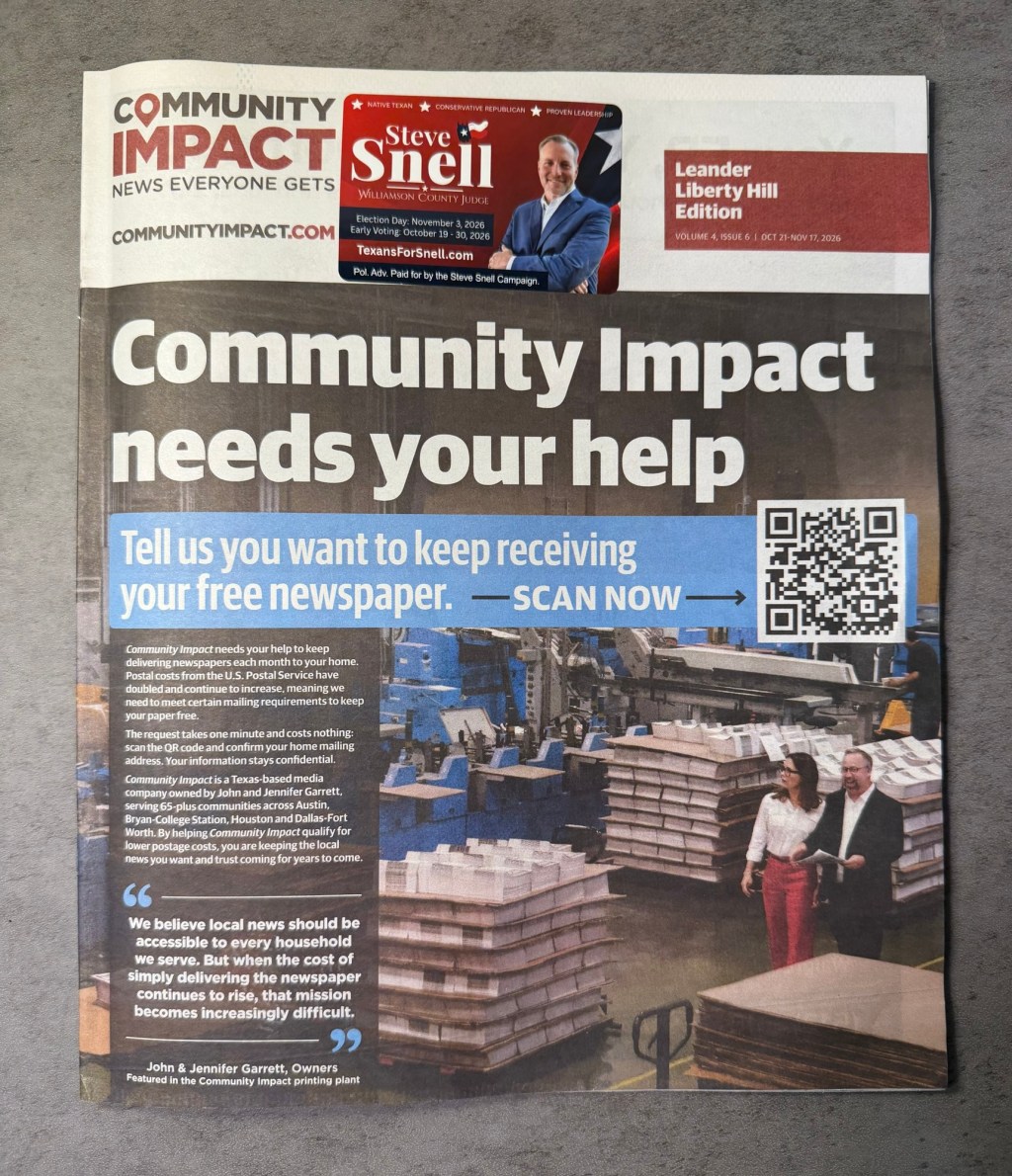
Community Impact is asking readers across its Texas newspaper editions to confirm that they want to continue receiving its free publications, a companywide initiative that appears consistent with efforts to qualify for a different U.S. Postal Service mailing classification.
The request, featured prominently in the company’s October 2026 print editions, directs readers to scan a QR code and verify their home mailing addresses. The newspaper says the process takes approximately one minute, costs nothing and will help it meet postal mailing requirements.
The announcement raises questions about whether Community Impact is pursuing what the Postal Service calls requester Periodicals mailing privileges, a classification that allows qualifying publications to receive discounted postage without requiring readers to purchase subscriptions.
Such a change would not necessarily mean the newspaper would be delivered exclusively to people who request it.
The company has not identified the specific postal classification it is seeking, and its existing mailing arrangements have not been independently confirmed.
Understanding second-class and third-class mail
For decades, newspapers and magazines have used a mailing classification commonly called second-class mail. The Postal Service now calls that category Periodicals Mail.
Third-class mail, meanwhile, is now generally known as USPS Marketing Mail. It is commonly used for advertising circulars, catalogs, promotional materials and other bulk mailings.
Both categories offer commercial mailing rates, but their eligibility requirements and pricing structures differ.
Marketing Mail allows businesses and publishers to distribute materials to large groups of households, including through saturation mailing programs that reach nearly every address along selected postal routes.
Periodicals Mail is intended for qualifying newspapers, magazines and other regularly published publications with established subscriber or requester circulation.
Traditional Periodicals eligibility generally depends on paid or qualifying circulation. However, the Postal Service also offers a requester publication category that permits free publications to qualify when enough recipients have affirmatively requested them.
Under USPS rules, at least 50% of a requester publication’s distributed copies must go to people who have specifically asked to receive it.
That requirement closely resembles the process Community Impact is asking its readers to complete.
What qualifies as a requested newspaper?
A requester publication does not have to charge its readers.
Instead, the publisher must maintain verifiable records showing that enough recipients have specifically requested the publication.
Those requests can be collected through written forms, telephone communications or online systems, provided they meet Postal Service documentation requirements.
A request remains valid for up to three years. After that, the recipient must renew the request for it to continue counting toward the publication’s qualifying circulation.
The Postal Service also requires requester publications to meet other standards, including publishing at least 24 pages per issue and observing restrictions on advertising content.
Generally, a requester publication cannot contain more than 75% advertising in more than one-quarter of its issues during a 12-month period.
Community Impact’s request for readers to scan a QR code and confirm their addresses could help establish the documented circulation needed to satisfy those requirements.
The newspaper says the information collected will remain confidential.
Does everyone have to request the newspaper?
Not necessarily.
One of the most important distinctions in the Postal Service’s rules is that a requester publication does not have to distribute every copy to someone who has requested it.
The basic eligibility requirement is that at least half of the publication’s distributed copies go to qualifying requesters.
For example, a publication distributing 100,000 copies could potentially satisfy the circulation threshold with 50,000 valid requests while continuing to distribute another 50,000 copies to other households.
However, meeting the overall 50% threshold does not automatically make every nonrequested copy eligible for the same Periodicals postage rates.
Separate Postal Service rules govern how many nonrequested copies can receive Periodicals pricing. The applicable limits depend on the mailing category, how the copies are prepared and whether they are mailed alongside requested copies.
Under the regular Outside-County Periodicals rules, nonrequested copies exceeding the ordinary 10% allowance may still qualify for Periodicals prices when included in properly presorted, combined mailings with requested copies. Otherwise, copies exceeding the allowance generally must be mailed at another applicable rate.
That means a publisher could potentially continue distributing newspapers beyond its verified requester list, using different mailing arrangements for different portions of its circulation.
The distinction is particularly relevant to Community Impact, which has historically emphasized broad household distribution rather than requiring residents to subscribe.
Why the distinction matters for Community Impact
Founded in 2005 by John and Jennifer Garrett, Community Impact built its readership around distributing free local newspapers to households in communities throughout Texas.
The company expanded from its original coverage in the Austin area into other major Texas markets, publishing localized editions covering government, development, transportation, education, restaurants and businesses.
Its longtime slogan, “News Everyone Gets,” reflects a distribution philosophy in which residents can receive a newspaper regardless of whether they actively seek out local news.
In announcing a 2022 rebranding, the company described its mission as providing trusted news and local information accessible to everyone.
A move toward requester circulation would introduce a different element to that model: documented reader interest.
Instead of treating every household within a geographic area as an equivalent recipient, the company would have a verified list of residents who specifically want the newspaper.
That could affect how circulation is documented and how delivery is organized without necessarily changing the publication’s free-access model.
It could also create a recurring requirement for readers to renew their requests every three years.
Is requester postage the same as traditional second-class postage?
Both traditional subscription-based Periodicals and requester Periodicals operate within the same general postal classification.
They are subject to many of the same postage calculations, including factors such as publication weight, advertising content, destination and mail preparation.
However, eligibility for certain discounted rates can differ.
For example, the Postal Service provides special In-County Periodicals rates for qualifying publications distributed within their county of publication.
The current Domestic Mail Manual includes provisions allowing qualifying requester copies to receive In-County prices under specified conditions. Older USPS guidance describes requester publications as ineligible for those rates, making the applicable current standards particularly important when evaluating a publication’s mailing options.
The relevant distinction is that requester status is not itself a separate class of mail with a universally lower price.
It is a way for qualifying publications without a traditional paid subscriber base to obtain Periodicals mailing privileges.
Other newspapers have adopted similar programs
Community Impact would not be the first free newspaper to pursue a mailing arrangement based on documented reader requests.
The Leader, a Missouri newspaper, has undertaken a similar initiative, asking residents to formally request continued delivery of its free publication.
In explaining the program, The Leader said the requests would allow it to apply for a new postal permit and create a verified mailing list.
The newspaper also told readers that requests would need to be renewed every three years.
Importantly, The Leader described the change as a way to maintain free home delivery, rather than introducing paid subscriptions.
The example illustrates how a free newspaper can move toward requester circulation while continuing to distribute its publication without charging readers.
What happens if readers do not respond?
That remains one of the central unanswered questions surrounding Community Impact’s announcement.
The newspaper is asking readers to confirm that they want continued delivery, but the notice does not explicitly state that households failing to respond will be removed from its distribution lists.
Nor does it establish a deadline after which unconfirmed households will stop receiving copies.
Under requester publication rules, a publisher could maintain a combination of requested and nonrequested circulation, subject to the applicable postal requirements.
Consequently, a household that does not scan the QR code might continue receiving the newspaper.
Alternatively, Community Impact could eventually prioritize households that have confirmed their interest or change how it distributes copies to unconfirmed addresses.
Neither outcome has been announced.
There is also no indication in the notice that readers will be required to pay for subscriptions.
What remains unknown
Several details would help establish exactly what Community Impact intends to accomplish.
The company has not publicly specified in the notice whether it currently mails its newspapers using USPS Marketing Mail, already holds Periodicals mailing privileges or is seeking a new requester publication authorization.
It has also not explained whether the confirmation campaign will eventually affect which households receive printed editions.
The Postal Service’s regulations establish a clear reason a free newspaper might want readers to affirmatively request delivery, but the regulations alone do not establish Community Impact’s intentions.
For now, the company’s message is straightforward: Readers who want to continue receiving the free newspaper are being asked to confirm their interest.
Whether the initiative ultimately changes Community Impact’s distribution footprint or simply establishes a verified readership while preserving broader delivery remains to be seen.

