
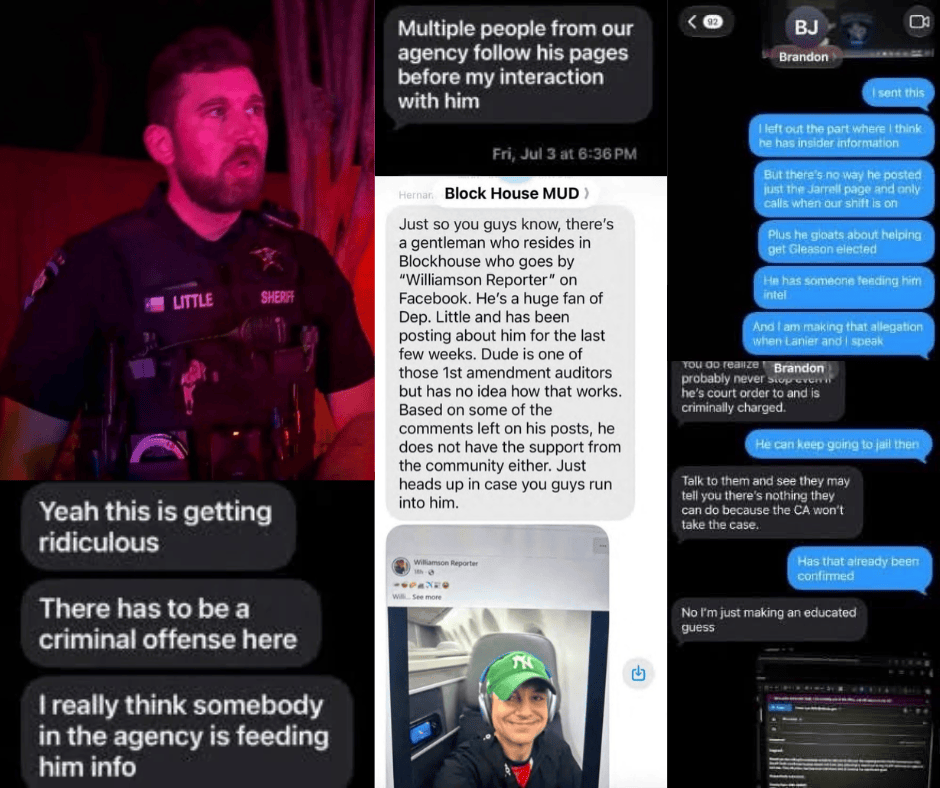
A Williamson County sheriff’s deputy who detained a local news publisher during a late-night walk later asked his own department whether the publisher’s reporting could be prosecuted as criminal harassment, according to records released by the Sheriff’s Office.
When Sgt. Brandon Jennings suggested David Flash would likely keep publishing even if he were charged and ordered by a court to stop, Deputy Ryan Little replied, “He can keep going to jail then.”
Flash, publisher of Williamson Reporter, said Little’s conduct unsettled him from the start of the May 23 encounter in Block House Creek. He said he was alone with Little at first, did not understand why he was being held and called someone so they would know where he was. The encounter ended without an arrest or citation. Flash said he left feeling unsafe in his own neighborhood and had lost trust in the Sheriff’s Office.
“There has to be a criminal offense here,” Little texted Jennings on June 30 after Flash published about the stop. Little asked how to contact the department’s Criminal Investigations Division. On July 5, he used his county email to ask Sgt. Ben Lanier whether the posts could qualify as harassment or another criminal offense.
An earlier draft named Flash. Jennings advised Little to leave the name out because the email was subject to open records. The version Little said he sent omitted it. Jennings also questioned whether the county attorney would take a case and recognized that Flash would argue the reporting concerned a matter of public concern. The Texas provision Little appeared to cite expressly excludes posts connected to such matters. Little anticipated that argument and wrote, “But it really isn’t.” tcss.legis.texas.gov
Records show hiring concerns about another deputy at the scene
Flash said he looked into the backgrounds of all the deputies who were present. He identified Christian Mowrer as one of them. In 2023 hiring records, two reviewers recommended against moving Mowrer forward. One questioned his maturity and judgment, citing prior encounters with law enforcement and concerns raised by references. Another reviewer flagged Mowrer’s admitted past drug use under the agency’s hiring policy but described him as a valued employee at the Trinity County Sheriff’s Office and suggested considering him for a nonsworn corrections position.
The hiring file also said a 2018 disorderly conduct charge in Maine was dismissed. It included favorable references and a reviewer’s assessment that Mowrer appeared to have taken responsibility for the incident by the time he applied.
Flash said his concerns about the other deputies stem from what they did at the scene. He alleges they failed to intervene in a detention he considers unlawful. In a separate group chat labeled “Block House MUD,” a participant described Flash as a First Amendment auditor and alerted others in case they encountered him. Flash said he publishes a local news outlet that covers business, government and community events, and questioned why deputies were discussing him that way after the stop.
Publisher disputes statements in official records
Flash said he never called, texted or privately messaged Little about the coverage, which he published on his news website and social media. He said Little has never identified a factual error in the reporting or requested a correction or retraction.
Flash said he served Little with a notice of libel over statements in government records that Flash contends are false. He said Little’s incident report and an Internal Affairs account citing body-camera footage attributed different statements to him and to witnesses. Flash earned a master’s degree from Arizona State University’s Walter Cronkite School of Journalism and Mass Communication and said he earned an A in media law during his graduate studies.
The released records do not show whether Lanier responded, whether the Sheriff’s Office opened a criminal investigation or whether anyone sought a warrant. Flash said he wants the department to explain what it did when a deputy asked whether the person he detained could face criminal charges for writing about it.

