
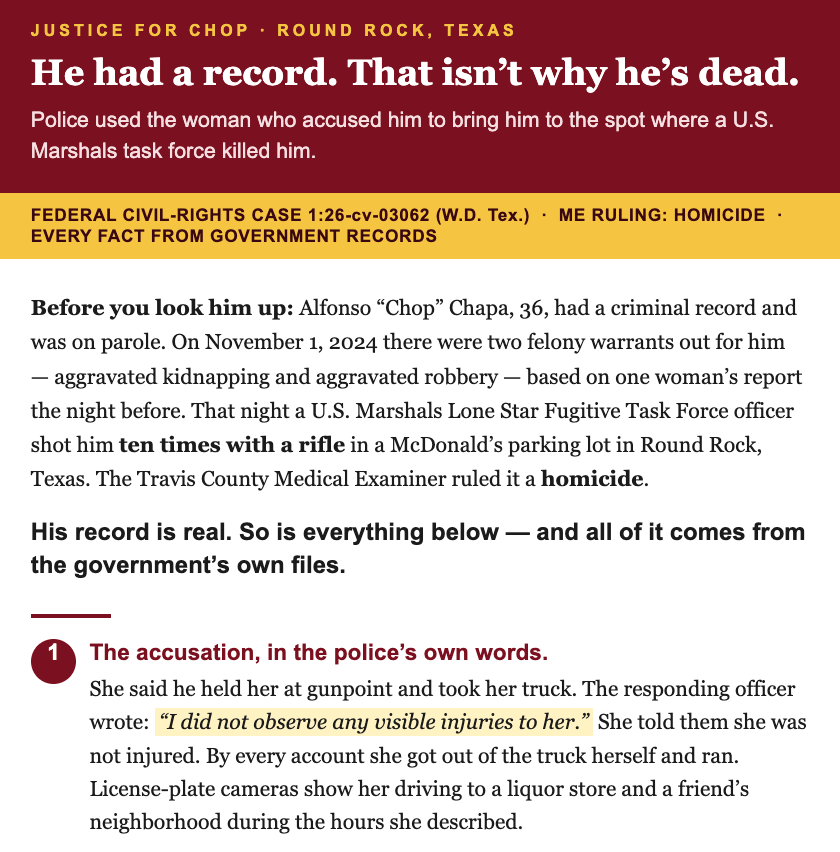
More than two years after a 36-year-old man was shot 10 times during an operation involving a U.S. Marshals fugitive task force outside a Round Rock McDonald’s, his family is seeking answers in federal court, raising questions about why authorities abandoned an earlier plan to arrest him peacefully, why his arrest warrants were temporarily removed from law enforcement databases and what happened in the moments before officers opened fire.
Alfonso Miguel Chapa, known to friends and family as “Chop,” was killed Nov. 1, 2024, outside the McDonald’s at 1850 E. Palm Valley Blvd. The Travis County medical examiner classified his death as a homicide, a medical determination that does not establish whether the shooting was legally justified.
On Oct. 30, 2026, Chapa’s parents and daughter filed what the family describes as a federal civil rights lawsuit in the U.S. District Court for the Western District of Texas, Austin Division. The family identified the case as 1:26-cv-03062 and said they filed without an attorney after unsuccessfully seeking legal representation.
The family also says it has submitted federal tort claims to the U.S. Marshals Service and sent evidence preservation requests to several law enforcement agencies.
The allegations are outlined in a detailed account compiled by a friend of Chapa with his family’s knowledge. The account cites records from the U.S. Marshals Service, Pflugerville Police Department, Round Rock Police Department and Travis County medical examiner. The underlying investigative files and federal complaint have not been independently authenticated for this report.
Chapa had a criminal history, was on parole and faced two felony arrest warrants involving allegations of aggravated kidnapping and aggravated robbery. Those allegations originated from a woman’s complaint to Pflugerville police on Oct. 31, 2024.
However, the family’s account identifies several circumstances surrounding his death that it argues deserve additional scrutiny.
According to a sworn statement attributed to a Pflugerville police investigator, authorities initially determined that the safest approach would be to arrest Chapa during his regularly scheduled parole appointment Nov. 6, five days after the eventual shooting.
The investigator reportedly told the complaining witness that authorities would not attempt to apprehend Chapa until the following week. The woman responded that she felt safe, according to the statement.
Despite that plan, law enforcement officers attempted to apprehend Chapa the following evening, resulting in his death.
Records cited by the family also indicate that Chapa’s warrants were entered into law enforcement databases at 4:24 a.m. Nov. 1, removed at 4:52 p.m. at a lieutenant’s request and re-entered at 7:15 p.m.
Chapa was shot approximately 30 minutes later.
The documents provided in the family’s account do not establish why the warrants were temporarily removed or who authorized the change in apprehension strategy.
Another significant question concerns the role of the woman who originally reported Chapa to police.
According to the account, the woman had accused Chapa of holding her at gunpoint and taking her truck. The responding investigator reported observing no visible injuries, and the woman said she had not been physically injured.
The following afternoon, according to a statement attributed to the woman, she visited Chapa’s parents’ home.
Later that evening, she was in contact with law enforcement officers near the location where Chapa would be killed.
Round Rock police dispatch records reportedly place a Pflugerville officer with the woman at a nearby bank at approximately 5:17 p.m.
The family’s account cites an officer’s report stating that the woman was instructed to answer a telephone call from Chapa and place it on speakerphone. Another officer reportedly wrote that the woman told Chapa her location and that he relayed that information to other officers.
Authorities subsequently established surveillance in the area.
Chapa arrived at the location, apparently intending to pick up the woman, and encountered members of the U.S. Marshals Lone Star Fugitive Task Force.
According to the federal incident report cited by the family, officers conducted a planned vehicle containment operation involving multiple law enforcement vehicles.
Chapa exited a Ford F-150 through a passenger-side window and attempted to flee.
One officer who was close to Chapa reportedly told Texas Rangers that he did not initially see anything in Chapa’s hands.
“When I exited my vehicle, I did not see anything in Chapa’s hands,” the officer stated, according to the account.
The officer described a physical confrontation near the wall of the restaurant before gunfire erupted.
Other statements cited by the family indicate that officers believed Chapa had produced a handgun and posed an immediate threat. One officer said he believed he and another investigator would have been killed had a fellow officer not fired.
Those accounts present a critical unresolved question: Whether Chapa was armed and threatening officers at the moment deadly force was used.
The medical examiner’s findings, as described in the family’s account, documented 10 gunshot wound paths, including three entrance wounds to Chapa’s back. Fifteen discharged rifle cartridge casings were reportedly recovered from the scene.
The autopsy also recorded that the range of fire could not be determined from the wounds. The family argues that the findings, together with the officers’ statements and physical evidence, warrant further independent examination.
Investigators also documented bullet impacts beyond the immediate shooting scene, according to the account, including damage to a law enforcement vehicle and an apartment building across the roadway.
The family has additionally questioned the handling and availability of video evidence.
The U.S. Marshals Service incident report reportedly indicated that no body camera footage existed, while also acknowledging that Pflugerville officers at the scene wore body cameras.
Other police records cited in the account describe officers securing camera equipment and uploading recordings.
It remains unclear which recordings exist, what they show and whether all relevant footage has been preserved or released.
The family also raises questions about the handgun reportedly recovered at the scene, including whether it was tested for Chapa’s fingerprints or DNA. The account says Chapa’s hands were preserved for gunshot residue testing but does not identify a corresponding test result.
Those omissions, if confirmed, could be significant in evaluating the competing accounts of the shooting.
Another issue involves the identity of the officer who fired the fatal shots.
The family says it has not received official confirmation of the officer’s identity, despite spending two years seeking information.
The U.S. Marshals Service records released under the Freedom of Information Act reportedly redacted officer names. However, a sworn statement contained in the Pflugerville police investigation appears to identify the officer who fired.
The person who compiled the family’s account cautioned that the identity has not been independently verified and should not be published without additional confirmation.
Chapa’s death received limited local media attention at the time.
FOX 7 Austin reported Nov. 2, 2024, that Round Rock police and federal marshals were investigating an incident outside the McDonald’s. The station reported that a photographer observed what appeared to be a body and bullet damage to a vehicle.
Round Rock police said their officers were assisting federal authorities and were not directly involved in the shooting.
The original coverage did not identify Chapa or provide a detailed account of the circumstances surrounding his death.
Now, his family is attempting to obtain answers through litigation.
The family’s account acknowledges Chapa’s criminal history and the serious charges he faced, but argues that those circumstances do not resolve whether the force used against him was justified.
The existence of felony warrants authorized officers to pursue his arrest but did not, by itself, establish that deadly force was necessary.
The central questions concern what threat Chapa posed when officers fired, whether authorities followed appropriate procedures and whether the evidence supports the officers’ descriptions of the confrontation.
The family’s account does not establish that officers committed a crime or violated Chapa’s constitutional rights. Those determinations would require examination of the complete investigative record, applicable law and evidence presented in court.
The case also raises questions about accountability when local law enforcement officers operate as members of federal task forces, including which agencies are responsible for investigating and responding to allegations of misconduct.
For Chapa’s family, the effort to obtain answers continues more than two years after his death.
The family’s account identifies several government records relevant to the investigation, including U.S. Marshals FOIA release 2025-USMS-000793, Pflugerville police report 24090551, Round Rock police report 2411010044 and Travis County medical examiner case PA 24-06590.
The relatives say they want the circumstances of Chapa’s death fully investigated, the identity of the officer who fired officially confirmed and the evidence surrounding the shooting made available for independent review.
Whether the lawsuit will establish constitutional violations remains to be determined. But the family argues that Chapa’s criminal past should not prevent a full accounting of how and why he died.

