
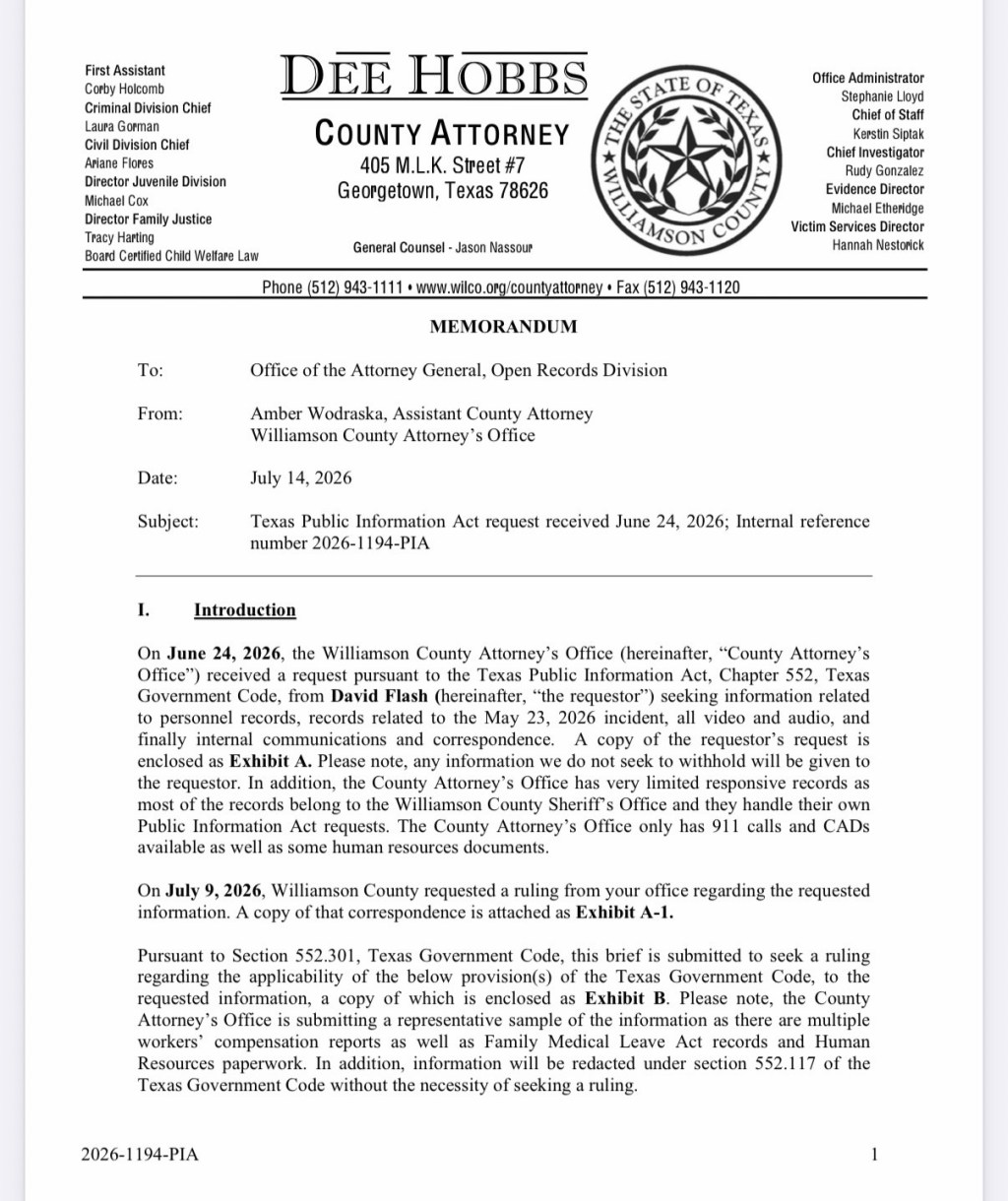
A Williamson County legal filing submitted to the Texas Attorney General’s Office in response to a public information request is drawing criticism over its quality, accuracy and the taxpayer resources required to produce and review it.
The seven-page memorandum seeks permission to withhold records related to a May 2026 detention involving Williamson County Sheriff’s Office deputies. The filing invokes multiple state and federal confidentiality provisions, including anticipated litigation, privacy protections, employment-related confidentiality laws, workers’ compensation confidentiality and the informer’s privilege.
Critics argue the filing contains factual errors, drafting mistakes, typographical errors and boilerplate legal arguments that appear only loosely connected to the central issue raised by the request.
Among the concerns cited is a reference to a “May 26, 2026 incident” despite the underlying request involving a May 23 detention. The memorandum also contains several grammatical and drafting errors, references to an “1-9” form rather than an I-9 form, and repeated explanations regarding the county’s method of submitting records to the Attorney General.
The filing has also been criticized for devoting substantial discussion to medical records, workers’ compensation documents, Family and Medical Leave Act records, payroll information and employment forms, despite the primary focus of the request being records related to the detention itself.
Questions have also been raised regarding the county’s reliance on the informer’s privilege to seek withholding of a 911 recording. Critics note that the filing does not clearly identify the specific violation of law allegedly reported by the caller or explain whether the person detained was even suspected of committing a criminal offense.
The dispute has renewed broader concerns about the costs associated with Texas public information disputes.
Under the Texas Public Information Act, governmental bodies that believe requested records may be exempt from disclosure can seek a ruling from the Attorney General’s Open Records Division. The process requires county personnel to gather and review records, attorneys to prepare legal arguments, and state attorneys and staff to review the submission and issue a ruling.
Government transparency advocates argue that the process can become costly when agencies broadly invoke multiple exceptions rather than releasing non-confidential records and redacting protected information.
Based on typical government labor costs, preparation and review of a filing of this nature can consume dozens of hours of combined county and state employee time. Critics estimate the total taxpayer cost could reach into the thousands of dollars before a ruling is issued.
The filing has also drawn criticism because the original request reportedly included an offer to narrow or modify portions of the request in an effort to facilitate production of records and reduce disputes over confidential information.
Supporters of the attorney general review process maintain that governmental entities have a legal obligation to protect confidential information and that seeking a ruling helps ensure compliance with state and federal law.
No ruling has yet been issued by the Texas Attorney General’s Office.
The dispute highlights a recurring tension in Texas government between protecting legitimately confidential information and ensuring prompt public access to records concerning government actions. Critics argue that the Williamson County filing demonstrates how public information disputes can evolve into lengthy and expensive legal exercises that delay disclosure while consuming taxpayer resources at both the local and state levels.

