
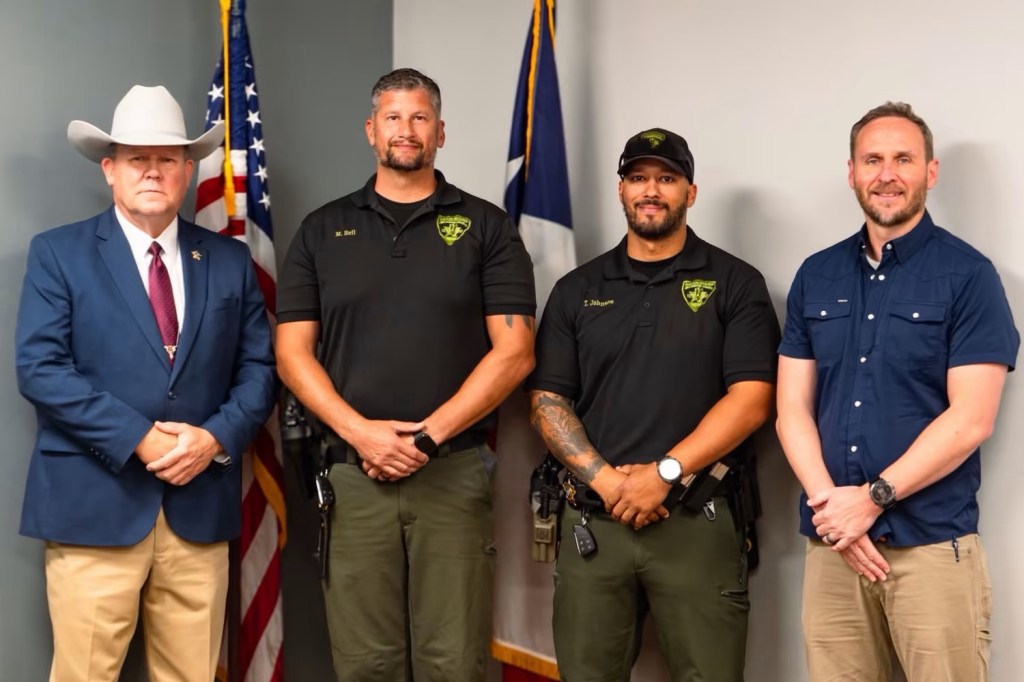
Two Williamson County sheriff’s deputies have been sworn in as federal task force officers, an appointment that raises questions about police accountability and the legal protections available to local officers operating under federal authority.
The Williamson County Sheriff’s Office announced that K-9 deputies Mark Bell and Tre’vone Johnson joined the U.S. Marshals Service Lone Star Fugitive Task Force. Their duties will include investigating and apprehending fugitives wanted for serious crimes alongside their K-9 partners, Omen and Ike.
U.S. Marshals Supervisory Deputy Christopher Rhoades administered the oath, according to the sheriff’s office.
While the appointments expand cooperation between local and federal law enforcement, they also raise questions about which government has authority over the deputies’ conduct and what happens when an officer is accused of violating someone’s rights.
An Austin police shooting provides a significant example of how federal task force status can change the outcome of a criminal case.
Austin officer avoided state prosecution after fatal shooting
On July 26, 2013, Austin police Detective Charles Kleinert fatally shot 32-year-old Larry Eugene Jackson Jr., an unarmed man, while investigating suspicious activity outside a bank that had been robbed earlier that day.
Kleinert had been employed by the Austin Police Department since 1994. In 2011, the FBI specially deputized him to serve on its Central Texas Violent Crimes Task Force.
Although Kleinert remained an Austin police detective, he worked full time with the FBI, reported to federal supervisors and investigated federal crimes.
After encountering Jackson outside the bank, Kleinert pursued him. The two struggled beneath an overpass, where Kleinert shot Jackson. Kleinert maintained that his firearm discharged unintentionally during the struggle.
A Travis County grand jury indicted Kleinert on a manslaughter charge.
But Kleinert argued that he had been acting as a federal officer and was therefore entitled to immunity from state prosecution under the U.S. Constitution’s Supremacy Clause.
In 2015, U.S. District Judge Lee Yeakel dismissed the indictment.
On April 20, 2017, the 5th U.S. Circuit Court of Appeals upheld that decision in State of Texas v. Kleinert, concluding that Kleinert was entitled to Supremacy Clause immunity under the circumstances established in the district court.
The ruling prevented Texas prosecutors from pursuing the manslaughter charge against Kleinert, despite his employment by the Austin Police Department.
The decision did not establish blanket immunity for federal task force officers. Rather, it demonstrated that local officers acting under federal authority may be protected from state prosecution when courts determine their actions were authorized and necessary and proper in carrying out federal duties.
The case is particularly relevant to Williamson County because the 5th Circuit’s decisions are binding precedent for federal courts in Texas.
Federal deputization changes the legal landscape
Ordinarily, county deputies accused of violating constitutional rights may be sued under Section 1983, a federal statute allowing civil rights claims against officials acting under color of state law.
But when county officers are performing federal duties, courts may determine that they were acting under federal rather than state authority.
That distinction can complicate lawsuits and potentially limit available remedies.
Claims against federal officers may instead fall under the framework established by the Supreme Court’s 1971 decision in Bivens v. Six Unknown Named Agents.
However, subsequent Supreme Court decisions have substantially narrowed the circumstances in which federal officers can be sued for constitutional violations under Bivens.
Federal task force officers may also invoke qualified immunity in civil litigation, although that protection is separate from the Supremacy Clause immunity Kleinert successfully asserted against state criminal prosecution.
The result is a complicated legal system in which a county deputy’s exposure to criminal prosecution and civil liability may depend partly on whether the deputy was exercising state or federal authority at the time of an incident.
Who oversees federally deputized county officers?
The U.S. Marshals Service describes the Lone Star Fugitive Task Force as a partnership involving federal, state and local law enforcement agencies.
Williamson County has already participated in the task force, along with the Austin Police Department and several other Central Texas agencies.
Such partnerships allow agencies to share investigative resources and pursue fugitives across jurisdictional boundaries.
But they also create questions about accountability.
If a Williamson County deputy assigned to the task force uses excessive force, which agency investigates the complaint?
If the deputy violates department policy while carrying out federal duties, can the sheriff impose discipline?
If the deputy is accused of committing a crime during a federal operation, can the Williamson County district attorney prosecute the case, or could the deputy invoke federal immunity?
And if a resident files a civil rights lawsuit, will the deputy be treated as a county official or a federal officer?
The answers depend on the circumstances of the incident, the terms of the task force assignment and applicable federal law.
The sheriff’s office announcement did not address those questions or explain what oversight procedures apply to Bell and Johnson while performing federal duties.
There is no indication that either deputy has engaged in misconduct.
Nevertheless, the legal questions extend beyond the conduct of any individual officer.
The Kleinert case demonstrated that federal deputization can have substantial consequences when a local officer’s actions result in someone’s death.
For Williamson County residents, the appointments raise a fundamental question about the relationship between local law enforcement and federal authority: When county deputies exercise federal powers, how much control do local officials retain, and what legal recourse remains available when those powers are abused?

