
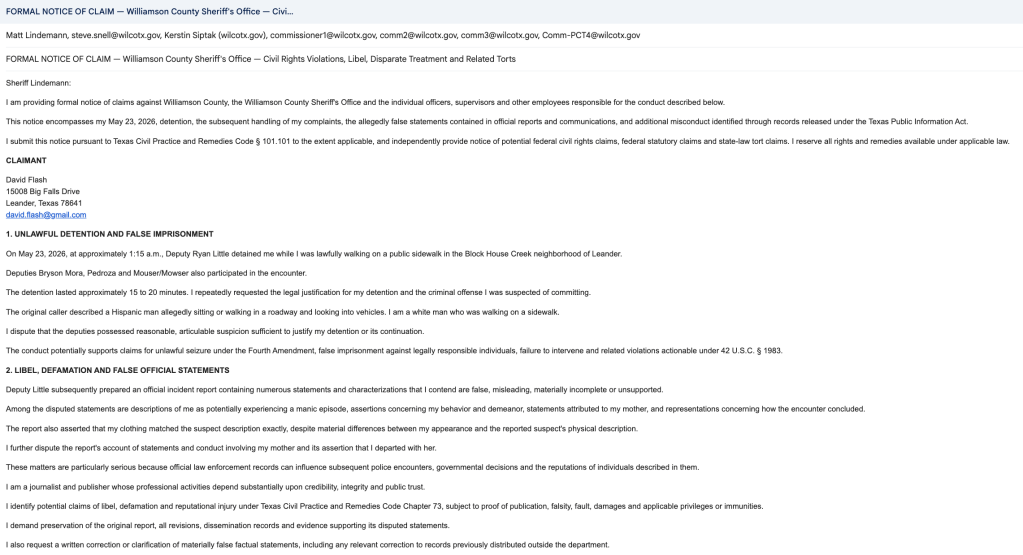
Williamson Reporter publisher David Flash has served a formal notice of claim against Williamson County and members of its Sheriff’s Office, alleging civil rights violations, false imprisonment, libel, disparate treatment and other misconduct arising from a May 23 detention and subsequent actions by department personnel. The notice was served on Sheriff Matt Lindemann, the Williamson County Attorney’s Office, County Judge Steven Snell and members of the Williamson County Commissioners Court.
The action follows months of public information requests, formal complaints and the release of government records that Flash says revealed additional potential misconduct beyond the original encounter. Flash said he deliberately obtained and reviewed substantial public information before pursuing the claim, an approach he recommends to others considering legal action against government officials. He cautioned, however, that public information requests do not suspend legal deadlines for filing claims or lawsuits.
Detained while walking on a sidewalk
The dispute began shortly after 1 a.m. May 23, when Deputy Ryan Little stopped Flash as he walked on a public sidewalk in the Block House Creek neighborhood of Leander. Flash said the detention lasted approximately 15 to 20 minutes and involved four deputies. The original dispatch described a Hispanic man allegedly sitting or walking in a roadway and looking into vehicles. Flash, who is white, maintains that he was walking lawfully on a sidewalk and had committed no crime. He alleges that deputies failed to identify a specific offense justifying his detention despite repeated requests for an explanation. The notice identifies potential Fourth Amendment claims for unreasonable seizure, along with false imprisonment and failure to intervene. The Sheriff’s Office previously classified Flash’s complaint concerning the detention as exonerated, indicating investigators concluded the conduct was lawful. Flash disputes that determination.
Released records lead to additional allegations
Flash subsequently obtained incident reports, dispatch information, internal communications and other records through the Texas Public Information Act. Those records formed the basis for additional complaints involving deputies and supervisory personnel. In his formal notice, Flash identifies potentially defamatory statements in Little’s official incident report, including characterizations suggesting Flash was experiencing a manic episode. Flash disputes the report’s descriptions of his behavior, its account of statements attributed to his mother and its representation that he matched the reported suspect description. He alleges the report contains material inaccuracies, unsupported conclusions and omissions that could damage his reputation. The notice identifies potential claims for libel and defamation and requests preservation of the report’s original version, subsequent revisions and records documenting its distribution. Whether those statements are legally actionable will depend on applicable defamation standards, privileges and governmental immunity.
Other records released by Williamson County included communications in which Little discussed Flash’s journalism and plans to file Internal Affairs complaints. “Apparently homie runs these pages, is calling IA on all of us,” one message attributed to Little stated. Another message referenced Flash’s objection to a deputy using the law enforcement designation “10-96,” commonly associated with a mental health concern. A separate participant in the exchange wrote, “Forgot to tell you but I found his 27 and he has…” The remainder of that message was redacted. The number “27” is commonly used in law enforcement radio communications to refer to driver’s-license information.
Flash has requested an investigation into whether an employee accessed his information through a law enforcement database, whether the access was authorized and whether information was disclosed for purposes unrelated to legitimate government duties. The federal Driver’s Privacy Protection Act allows civil claims involving certain impermissible uses or disclosures of protected motor vehicle information. The released exchange does not, by itself, establish that an unlawful database search occurred.
Sheriff’s Office complaint system challenged
The notice also addresses problems Flash encountered attempting to submit complaints through the Sheriff’s Office’s publicly advertised procedures. Flash said he submitted formal complaints using an email address the department identified as its complaint channel, but Internal Affairs later informed him that it had not received the submissions. The department subsequently corrected the publicly advertised email address after Flash raised the issue. Flash contends the error delayed his complaints and raises broader questions about whether other citizens experienced similar problems. He also challenged department instructions suggesting that complaints could be submitted only through a particular procedure. The notice identifies potential disparate treatment and unequal protection claims, subject to establishing the elements required under federal law.
Three original complaints were assigned case numbers CIT2026-018, CIT2026-019 and CIT2026-020. The Sheriff’s Office eventually classified one as exonerated and two as unfounded. Flash challenged the findings and the investigative process, including the time required to complete the investigations and the apparent failure to interview witnesses. He said investigators requested his mother’s contact information but did not interview her, to his knowledge. Subsequent complaints involved Lt. Michael Klier, Sgt. Gil Unger, Sgt. Brandon Jennings, Deputy Jacqueline L. Sirkis and Little. The allegations concern investigative procedures, disputed official statements, unprofessional communications and possible misuse of governmental information systems. The allegations have not been independently adjudicated.
Notice identifies potential federal and state claims
The formal notice identifies possible causes of action under the First, Fourth and 14th Amendments, along with federal civil rights statutes and applicable Texas law. Among the potential claims are unlawful detention, false imprisonment, First Amendment retaliation, unequal protection, libel, defamation, invasion of privacy and unauthorized use or disclosure of protected personal information. The notice also addresses potential county liability involving policies, customs, training and supervision. Federal law allows certain constitutional claims against government officials, while counties may face liability when an official policy or custom causes a constitutional violation. However, governmental immunity substantially limits many state-law tort claims against Texas counties, particularly intentional torts. Serving a notice of claim does not establish liability or mean that a lawsuit has been filed.
Advice to others: Get the records first
Flash said his experience illustrates the importance of understanding the factual record before pursuing legal action against government officials. Over several months, he obtained records, compared official accounts with available evidence, documented discrepancies and submitted additional requests as new information emerged. He said the process revealed issues that were not apparent immediately after the original detention. Among the records he recommends obtaining, where available, are body-camera footage, dispatch recordings, incident reports, internal communications, complaint files and records showing how government employees accessed or shared information.
Public information laws provide a means of obtaining evidence that may be important in assessing whether government misconduct occurred. However, requesting records does not stop statutes of limitations or extend applicable notice deadlines. Individuals considering claims should determine those deadlines promptly, even while records requests remain pending. Flash’s approach was to build the factual foundation of his allegations before formally notifying county leadership of potential litigation.
County leadership notified
The notice was delivered to Sheriff Lindemann, the County Attorney’s Office, County Judge Snell and county commissioners. It demands preservation of evidence, including recordings, original reports, electronic communications, Internal Affairs materials and database access logs. It also seeks acknowledgment of the claim, identification of the appropriate county claims representative and review of potentially inaccurate official records.
The notice identifies alleged injuries involving deprivation of liberty, emotional distress, reputational damage and time spent investigating and challenging the department’s conduct. No specific monetary settlement demand was included. The Texas Tort Claims Act generally requires notice of qualifying claims within six months, subject to applicable exceptions and local provisions. The six-month anniversary of the May 23 encounter is Nov. 23.
The dispute now extends beyond the initial pedestrian detention to questions concerning the accuracy of official records, handling of personal information, the integrity of internal investigations and the public’s ability to hold law enforcement agencies accountable. The Sheriff’s Office previously rejected the merits of Flash’s original complaints through its Internal Affairs findings. Its response to the newly served notice of claim has not yet been established.

