
A dispute between Williamson Reporter publisher David Flash and the Williamson County Sheriff’s Office is raising questions about whether the agency’s citizen complaint procedures comply with Texas law.
The issue stems from complaints Flash filed against Williamson County deputies following a May 23 detention in Leander. According to Flash, the complaints were submitted in writing, signed, and emailed to the Sheriff’s Office using an email address publicly provided for citizen complaints.
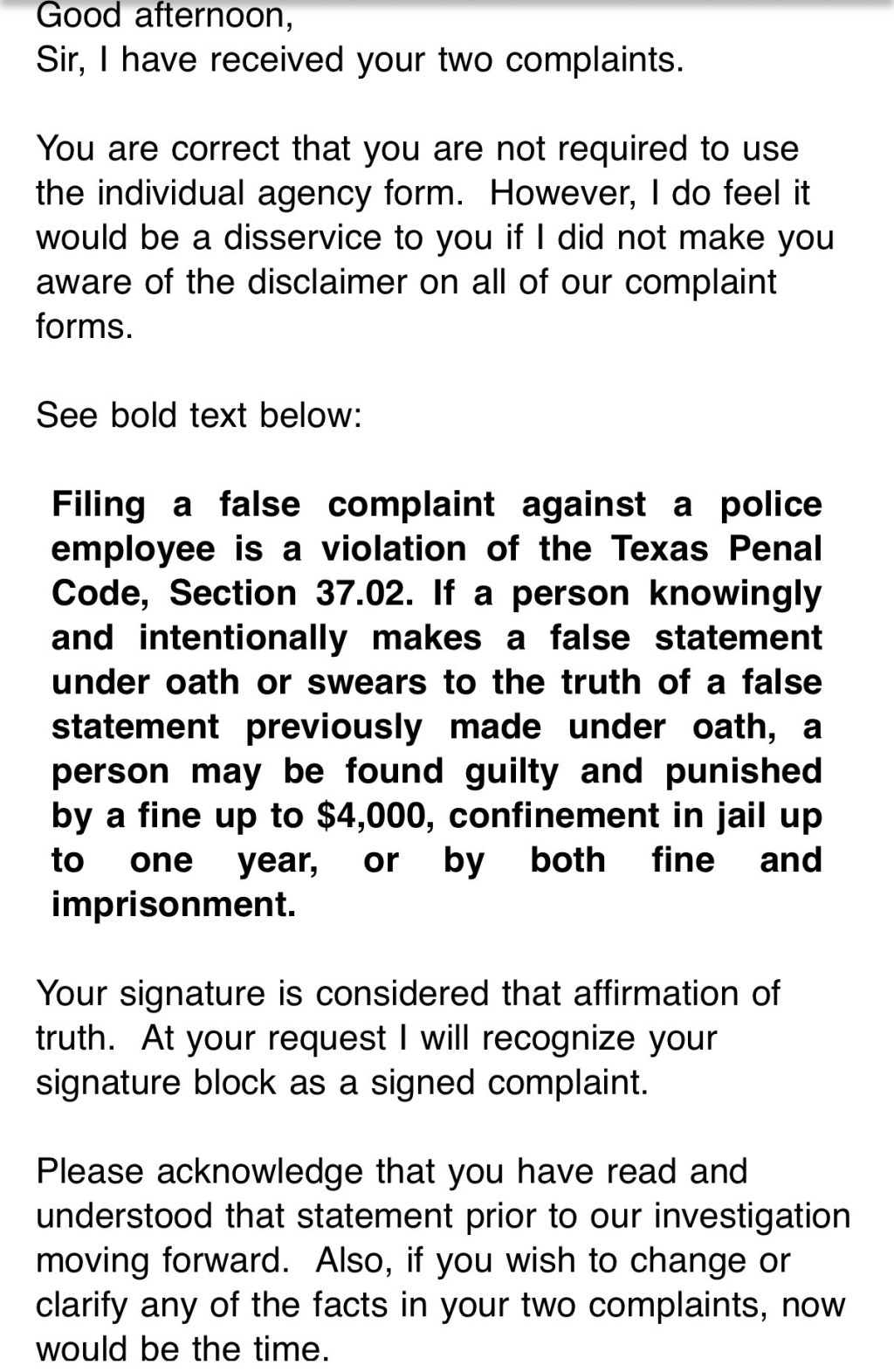
Weeks later, Flash received a response requesting an additional acknowledgment stating that he understood knowingly providing false information to law enforcement can be a criminal offense.
Flash declined.
“My complaints were submitted in writing and signed,” Flash said. “I am not agreeing to additional procedural requirements that do not appear anywhere in Texas Government Code.”
At the center of the dispute is Texas Government Code Chapter 614, which governs complaints against peace officers.
Section 614.022 states that complaints must be in writing and signed by the person making the complaint before disciplinary action may be taken against an officer. The statute does not require citizens to use a specific agency complaint form, nor does it expressly require additional certifications or acknowledgments.
In correspondence with the Sheriff’s Office, Flash asked whether his complaints were received when they were originally sent and, if so, why they were not considered filed at that time.
“If the Sheriff’s Office received the complaints when they were originally submitted, then they should have been processed at that time,” Flash said. “If they were not received, I would like to know why.”
The underlying complaints arise from a late-night encounter on May 23 in the Block House Creek area of Leander.
Flash says he was walking in his neighborhood shortly after 1 a.m. when Williamson County Deputy Ryan Little stopped him and informed him he was being detained. According to Flash, he repeatedly asked what crime he was suspected of committing but was never given a clear answer. The detention lasted approximately 15 to 20 minutes and involved multiple deputies before ending without an arrest, citation, or warning.
Since the encounter, Flash has sought body camera footage, dispatch records, and other documents related to the stop while publicly questioning whether the detention was lawful.
The dispute has now expanded beyond the detention itself to the Sheriff’s Office complaint process.
Flash says he believes the agency’s current practices may be inconsistent with Texas law and plans to publish additional reporting on the issue.
“I think this is a matter of public interest because it affects every citizen who may want to file a complaint against a deputy,” Flash said. “If the law says a complaint must be in writing and signed, then that should be the standard.”
Flash said he would prefer that the Sheriff’s Office voluntarily review its policies rather than face litigation.
“My goal is not money damages,” he said. “My goal is compliance. If there is a policy that conflicts with Texas law, it should be corrected.”
Flash also noted that governmental entities can face liability when unconstitutional actions result from official policies, customs, or practices, citing the U.S. Supreme Court’s decision in Monell v. Department of Social Services.
While no court has determined that the Williamson County Sheriff’s Office has violated state law or constitutional rights, Flash argues the agency should review its procedures to ensure they align with Texas Government Code requirements.
“The solution seems simple,” Flash said. “Look at the statute and make the policy match the statute.”
As of publication, the Williamson County Sheriff’s Office had not publicly responded to questions regarding whether Flash’s original complaints were received when submitted, whether the requested acknowledgment is required by departmental policy, or whether any review of the agency’s complaint procedures is underway.
Flash said he intends to continue pursuing answers regarding both the May detention and the Sheriff’s Office’s handling of citizen complaints.
“I’d like to know whether my complaints were received when they were originally submitted,” Flash said. “And if the Sheriff’s Office determines its procedures need to be changed, I’d like the public to know that too.”

